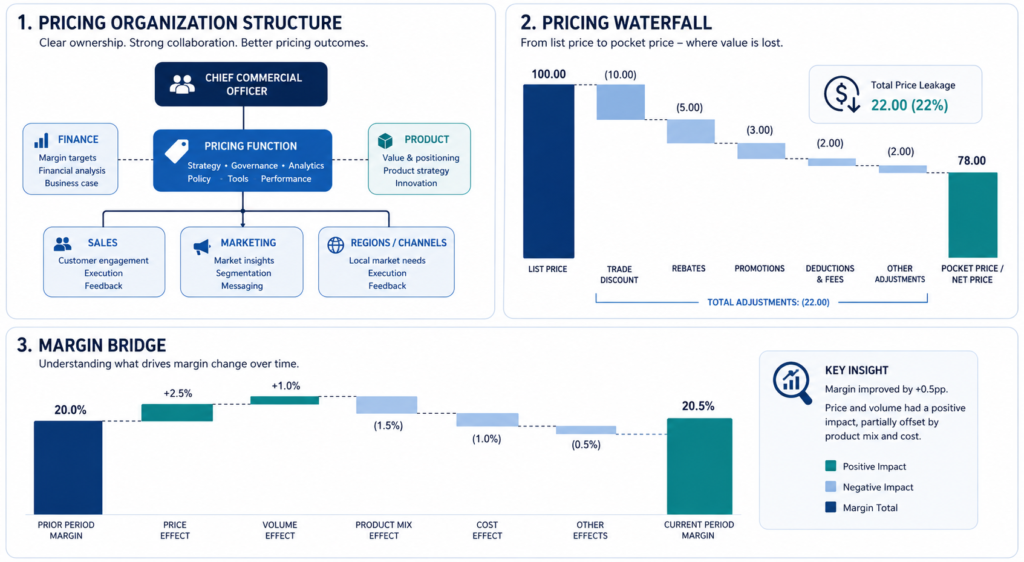

In today’s volatile business environment, pricing has not become easier to manage. Rising costs, supply chain disruptions and shifting customer demand are forcing companies to make pricing decisions faster and more frequently. Yet many organizations still struggle to maintain consistent margins.
The issue is often not pricing strategy itself. It is the lack of clear ownership and organizational structure behind pricing decisions.
When pricing responsibilities are spread across multiple teams without coordination, inconsistency follows. Sales teams negotiate independently, finance focuses on short-term targets, and regional teams apply different pricing rules based on local pressures. Over time, these small decisions accumulate, creating price leakage and weakening profitability.
Why Pricing Ownership Matters
Pricing is one of the most powerful drivers of profitability. Even small improvements in price execution can significantly increase margins. However, achieving consistent results requires more than updating price lists or reacting to market changes. It needs discipline.
Strong pricing organizations establish clear accountability for:
- Pricing strategy and governance: What objectives do we set ourselves?
- Discount and rebate management: What incentives do we need to move our distributors and/or customers?
- Approval processes and pricing exceptions: Who decides, to what degree and with what motivation?
- Margin monitoring and price realization: Are we obtaining the desired results? Are Customer segments behaving as expected?
- Alignment between commercial and financial objectives: Are our corporate financial objectives achievable with the current sales approach?
Without clear ownership, pricing decisions become reactive rather than strategic. Discounts become routine, exceptions increase, and visibility into true profitability declines.
The Cost of Fragmented Pricing Decisions
Many organizations operate with decentralized pricing processes. While this can create flexibility, it often results in conflicting priorities and inconsistent execution.
Common warning signs include:
- Different pricing practices across regions or channels
- Discounts applied without clear controls
- Incentives focused on revenue instead of profit
- Limited visibility into margin erosion
- Growing gaps between list price and pocket price
These problems become even more damaging during periods of market uncertainty. Cost volatility and competitive pressure amplify weaknesses in pricing discipline and governance.
What Effective Pricing Organizations Do Differently
Successful companies treat pricing as a structured business capability rather than a purely sales-driven activity.
They typically focus on four key areas:
- Clear Governance: Defined pricing ownership ensures consistent decision-making across teams and markets.
- Controlled Flexibility: Sales teams retain the ability to respond to market conditions, but within structured pricing guardrails that protect margins.
- Data-Driven Visibility: Organizations use tools such as Pricing Waterfall analysis and Margin Bridge analysis to understand where value is gained or lost across pricing, discounts, volume, and product mix.
- Profitability Alignment: High-performing organizations align incentives, approvals, and KPIs with long-term profitability instead of short-term volume growth.
Building a Sustainable Pricing Organization
There is no universal pricing model, but effective pricing organizations usually share three characteristics:
- Centralized visibility into pricing performance
- Clear accountability for pricing decisions
- Strong collaboration between sales, finance, marketing, and product teams
As pricing complexity continues to grow, strong ownership and governance are becoming essential for sustainable margin performance.