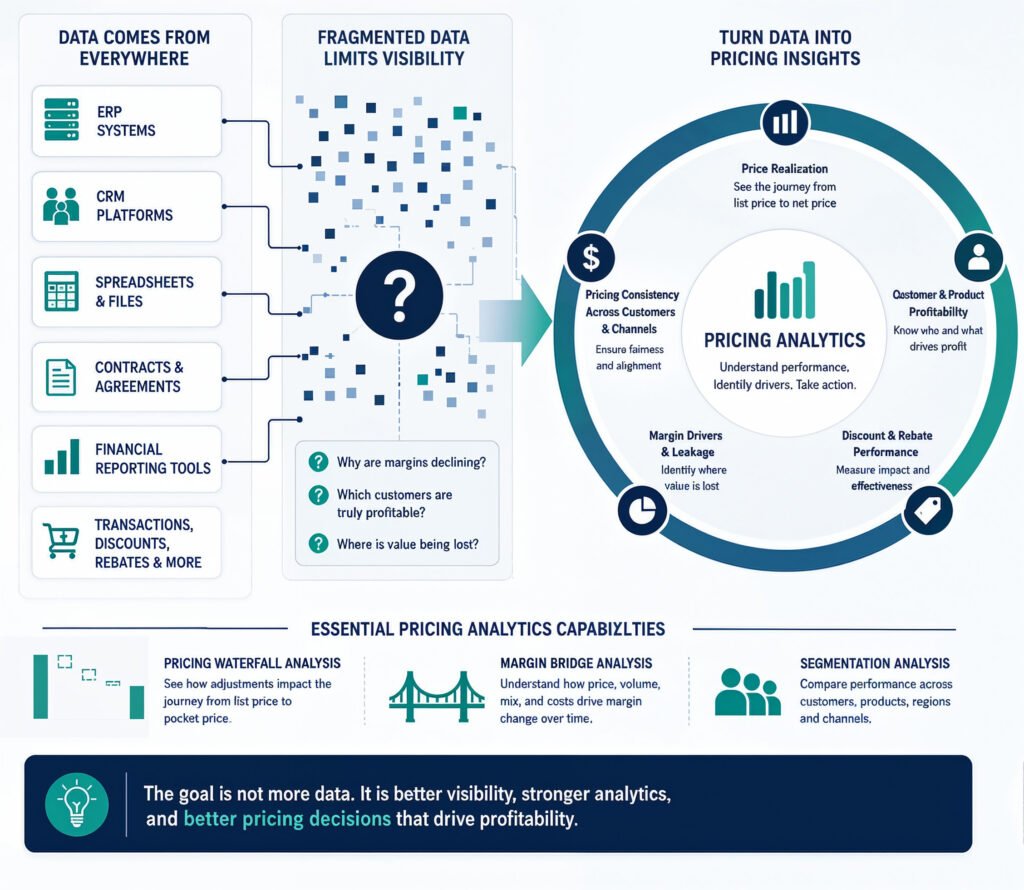

In today’s business environment, companies generate more (pricing related) data than ever before. Every transaction, discount, rebate, promotion, and customer interaction creates new information. Yet many organizations still struggle to answer fundamental pricing questions;
Why are margins declining? Which customers are truly profitable? Where is value being lost?
The challenge is often not a lack of data. It is the inability to transform fragmented information into actionable pricing insights.
Many companies have invested heavily in ERP systems, CRM platforms, and reporting tools. However, pricing data often remains spread across multiple systems, making it difficult to build a clear picture of pricing performance and profitability. As a result, pricing decisions are frequently based on assumptions rather than facts.
Why Pricing Data Matters
Pricing is one of the most powerful drivers of profitability. However, organizations need more than list prices and revenue reports to manage it effectively.
They need visibility into:
- Price realization
- Customer and product profitability
- Discount and rebate performance
- Margin drivers and leakage
- Pricing consistency across customers and channels
Without reliable data, companies often focus on revenue while overlooking profitability.
The Reality of Pricing Data Today
Many organizations believe they are data rich. They are however often insight-poor.
Common challenges include:
- Fragmented Data: Pricing information is often spread across ERP systems, CRM platforms, spreadsheets, contracts, and financial reporting tools. This makes pricing performance difficult to analyze consistently.
- Limited Margin Visibility: Many companies understand their list prices but struggle to understand what happens between list price and realized margin. Discounts, rebates, promotions, and commercial agreements often reduce profitability without clear visibility.
- Reporting Without Action: Organizations generate reports that describe what happened. Effective pricing analytics should help explain why it happened and what action should be taken.
Essential Pricing Analytics Capabilities
Successful organizations focus on a small number of high-impact analytics capabilities.
- Pricing Waterfall Analysis: Shows how discounts, rebates, incentives, and other adjustments impact the journey from list price to pocket price.
- Margin Bridge Analysis: Explains how factors such as price, volume, product mix, and costs affect profitability over time.
- Segmentation Analysis. Compare pricing and margin performance across customers, products, regions, and channels to identify opportunities and inconsistencies.
Together, these tools provide a clearer understanding of where value is created, retained, or lost.
What Good Pricing Data Infrastructure Looks Like
There is no universal technology solution, but effective pricing organizations usually share three characteristics:
- Connected Data: Sales, finance, pricing, and commercial data are integrated into a consistent view on performance.
- Consistent Metrics: Margin calculations, customer segmentation, and pricing measures are standardized across the organization.
- Decision-Focused Analytics: Analytics support pricing decisions rather than simply producing reports.
Building a Sustainable Pricing Analytics Capability
Many companies begin by investing in new tools. However, technology alone rarely solves the problem.
The most successful organizations combine reliable data, clear governance, and practical analytics that support commercial decision-making. The objective is not to collect more data. It is to create visibility that enables better pricing decisions, stronger margin management, and sustainable profitability.
As pricing complexity continues to increase, organizations that can turn pricing data into actionable insights will be better positioned to protect margins and drive profitable growth.